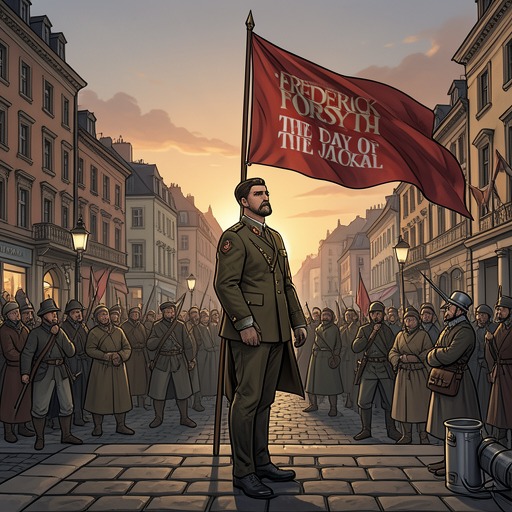
Appeal of 18 June
The Day of the JackalThe Appeal of 18 June is presented as both a wartime call to continue the struggle and a political force that returns decades later. In the novel, Charles de Gaulle’s words reach soldiers by radio during the 1961 putsch, helping to break the revolt; later, the appeal’s date and message surface in The Jackal’s reconnaissance of a Paris square renamed in de Gaulle’s honor.
The appeal and the putsch
On 18 June 1940, Charles de Gaulle, speaking from exile in London, addressed the French after their defeat in a battle. The message recalled in the novel turns that defeat into a demand for continued allegiance: “You are faced with a choice of loyalties. I am France, the instrument of her destiny. Follow me. Obey me.” Its force rests on the contrast between a lost battle and an unfinished war, and on de Gaulle’s claim to embody France’s destiny.
That earlier appeal acquires immediate practical significance during the April 1961 military putsch. In the weeks before the revolt, thousands of transistor radios had been issued to troops across Algeria. Officers regarded them as harmless comforts, useful for carrying French pop music into barracks marked by heat, flies, and boredom. But when the Army’s loyalty was tested, conscripts turned on those same radios and heard de Gaulle’s voice after the news. The appeal thus returned not as distant history but as a direct choice of loyalty.
The revolt’s defeat and aftermath
The radio broadcasts helped deprive the putsch of the support its commanders expected. Some battalion commanders awoke to find that only a handful of officers and most of their sergeants remained with them. The revolt was broken through a medium its leaders had treated as an amusement; the broadcast overturned their confidence in the Army’s allegiance.
Marc Rodin retained 120 officers, non-commissioned officers, and enlisted men. His unit had a higher proportion than most of experienced veterans from Indochina and the Algerian fighting. Along with the other putschists, Rodin’s surviving force formed the Secret Army Organisation, pledged to overthrow de Gaulle. The appeal’s later role in the novel is therefore bound to both the failure of the putsch and the emergence of a clandestine movement against the president.
A remembered date in Paris
The appeal returns in a different register when The Jackal surveys the square at the southern end of the Rue de Rennes on July 28. Once called the Place de Rennes, it had been renamed Place du 18 Juin 1940 after the Gaullists took power in the City Hall. The Jackal’s gaze settles on the new nameplate, prompting recollection of what he had read the previous month about the lonely exile in London and the appeal that declared that France had lost a battle, not the war.
The surrounding square carries the same history in its setting: Gare Montparnasse stands on its southern side, while traffic streams in from the Boulevard du Montparnasse, Rue d’Odessa, and Rue de Rennes. For Parisians of the war generation, the place is laden with memories; for The Jackal, its commemorative name briefly interrupts the practical work of choosing a site. The appeal links public memory to the present-day plot, making the square’s name a reminder of de Gaulle’s wartime authority even as the assassin examines the ground around it.